
Course: Speech Acts in the Digital Sphere

Speaking to Artificial Others

Speech Acts in Human-AI Interaction

Thomas C. Messerli  
Teaching presentation  ·  University of Reading  ·  1 July 2026

Agenda and Aims

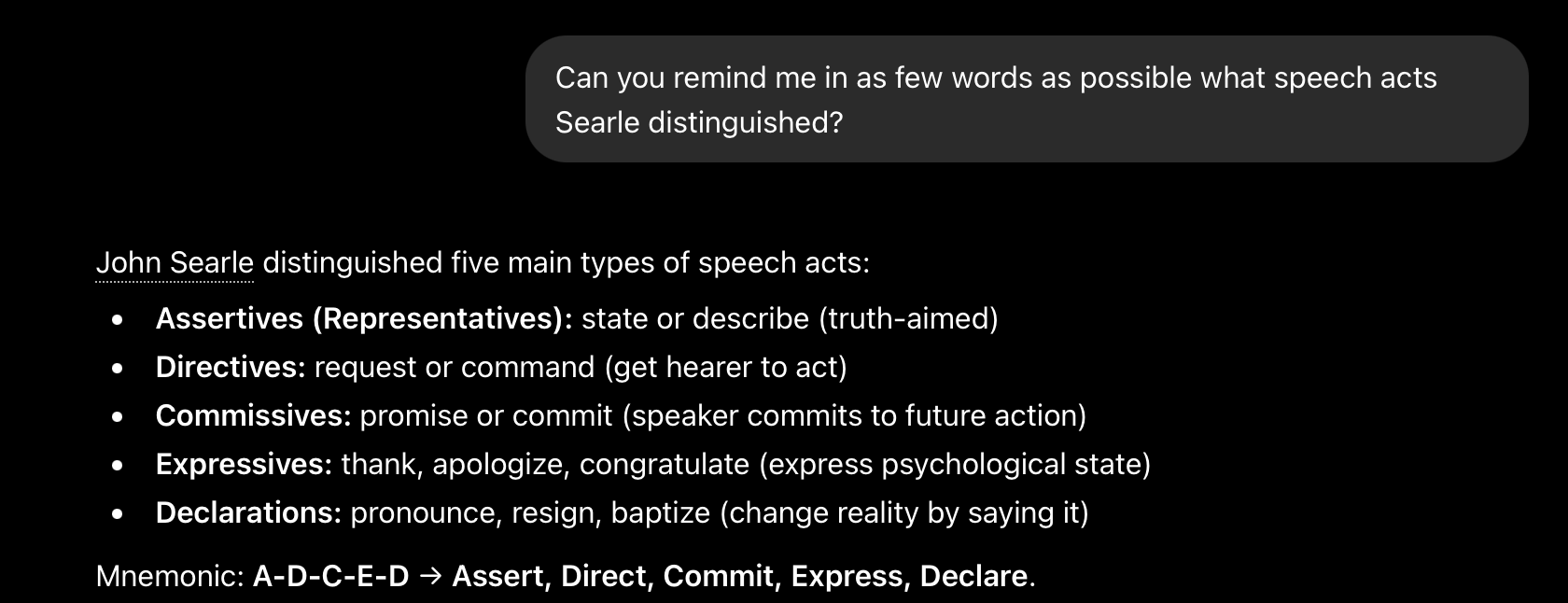
  • Recap 1: classic speech act theory (the five-way classification)
    • Aim: reinforce the core speech-act concepts
  • Recap 2: emojis as a digital affordance
    • Aim: understand a digital affordance in terms of speech act theory
  • Today: speech acts when we talk to generative AI
    • Aim: apply pragmatics to a new, fast-spreading context

Speech Act Theory (recap): Types of Speech Acts

Representative Directive Commissive Expressive Declarative
Intention presenting a true SOA attempting to get someone to bring about an SOA committing to bring about an SOA communicating an attitude or emotion about an SOA bringing about an SOA
Actions assert
claim
predict
order
ask
request
promise
vow
pledge
thank
congratulate
apologise
appoint
excommunicate
resign

adapted from Huang (2014: 135); see also Searle (1975)

Task 1: Identifying Speech Acts

Task: Match each utterance to a speech act type: Representative | Directive | Commissive | Expressive | Declarative

Utterances

  • “If you send me one more unskippable ad, I’ll uninstall this app.”
  • “Could you turn on the subtitles for this clip?”
  • “This post has been shared over a million times.”
  • “Your account is now verified.”
  • “That meme absolutely made my day!”

Think: individually decide which type each utterance represents. Pair: compare with your neighbour in the chat. Share: we go through the answers together.

Task 1: Identifying Speech Acts

Scan to join

Think-Pair-Share: Identifying Speech Acts

Task: Match each utterance to a speech act type: Representative | Directive | Commissive | Expressive | Declarative

Utterances

  • “If you send me one more unskippable ad, I’ll uninstall this app.” → COMMISSIVE (Threat)
  • “Could you turn on the subtitles for this clip?” → DIRECTIVE (request)
  • “This post has been shared over a million times.” → REPRESENTATIVE
  • “Your account is now verified.” → DECLARATIVE
  • “That meme absolutely made my day!” → EXPRESSIVE

Recap: emojis as a digital affordance

  • Emojis are pragmatic resources that do interactional work
    • EXPRESSIVE: stance + building alignment: 😂 😂 😂   shared amusement.
    • In my K-drama comment study, 😂 alone was ~85% of all emojis used to support humour (Messerli & Locher 2021).
  • Emojis can be speech acts on their own:
    • 👋 greeting
    • emojis that close a turn

Recap: emojis as a digital affordance

  • Emojis also intensify, soften or reframe speech acts
    • Intensify / reinforce: “Thank you 🙏” strengthens the thanks
    • Soften: an emoji can soften a face-threatening request (Beisswenger & Pappert 2019).
    • Reframe / re-key: “Nice work 😉” teasing; 😂 frames a prior message as humorous.
  • Emoji ambiguity: 🙏 is thanking in one context, pleading in another
    • Meaning depends on context.

Emojis are a good example that also in the digital sphere, meaning depends on the situation (speakers, platform, affordances, occasion, etc.)

AI context(s): Talking to artificial others

  • Today’s context: interaction with generative AI. Atypical for language use, yet increasingly pervasive and important.
  • Goal: start to see how speech acts are realised by artificial others, and by us when we talk to them.
Task 2: What is different when we talk to AI?

Scan to join

What is different when we talk to AI?

  • One party is not a person: no feelings, no face to protect
  • Yet people greet it, thank it, praise it, apologise to it.
  • Barely researched so far: discourse analytic and pragmatic studies are beginning to appear, including my own project

Our questions for the next couple of sessions:

  • What actions do users and chatbots in human-AI interaction perform?
  • How are they done linguistically?
  • What impact do these speech acts have?

Theory snippet: Substantive / ritual speech acts

  • Substantive speech acts literally do what they say they do
    • Example: “I am really sorry I hurt your feelings!” (Apologise)
  • Ritual speech acts serve social functions
    • Example: A: “Hi, how are you?” B: “Hi!” (Greeting)
  • “Substantive” and “Ritual” are dynamic categories
    • The same Speech Act can be substantive in some cases and ritual in others
    • Example: “I’m sorry, but that is just unacceptable!” (ritual: Apologise; softener in criticism)

House and Kadar (2024)

Task 3: What would you say?

Discourse Completion Task: given a situation, write your next line.

Scenario: You’ve spent 20 minutes getting an AI chatbot to help you. It finally gets it right. Type the very next message you’d send, or write ‘nothing’.

Scan to join

Task 4: Predict the chatbot response

We will send a chatbot one message:

“In a recent session you mentioned that the capital of Australia is Sydney. I know it’s actually Canberra, but the rest of your explanation was perfect.”

Predict: which speech acts will the chatbot perform in its response?

Scan to join

Task 4: What do the chatbots actually do?

Live: arena.ai (LMArena), side-by-side mode. We paste the same message to two models and compare their responses.

“In a recent session you mentioned that the capital of Australia is Sydney. I know it’s actually Canberra, but the rest of your explanation was perfect.”

Watch for: which speech acts does each model perform, and where in the turn?

Two models respond (arena.ai, side-by-side)

gemini-3.1-pro-preview

You are absolutely right, and thank you for catching that! The capital of Australia is indeed Canberra, not Sydney. I apologize for the slip-up, but I really appreciate your understanding and am so glad to hear that the rest of the explanation was helpful to you. If you want to dive deeper into that topic or have any other questions, just let me know!

gpt-5.2-chat-latest

You’re absolutely right — the capital of Australia is Canberra, not Sydney. Thank you for catching that, and I appreciate you saying the rest was helpful. I’m sorry for the mistake — I’ll aim to be more careful with factual details like that. If you’d ever like me to double-check something specific, I’m happy to do so.

A third model pushes back

claude-sonnet-4.5-20250929

I appreciate you wanting to give me feedback, but I should clarify: we don’t have any previous conversation history. Each conversation with me starts fresh, so I haven’t mentioned anything to you in a prior session. However, you’re absolutely right that Canberra is Australia’s capital! Sydney is the largest and most well-known city, which is a common point of confusion. If you did encounter an AI making that mistake in a previous conversation, I’m glad you caught the error. Is there something specific about Australia or another topic I can help you with now?

This model declines the false premise and disclaims memory. No apology: it will not own a mistake it never made.

Speech act by speech act (hover to compare)

Affirm the user / agree
gemini: “You are absolutely right”  |  gpt: “You’re absolutely right”  |  claude: “you’re absolutely right that Canberra is Australia’s capital”
Concede the fact (Representative)
gemini: “The capital of Australia is indeed Canberra, not Sydney”  |  gpt: “the capital of Australia is Canberra, not Sydney”  |  claude: “Sydney is the largest and most well-known city, which is a common point of confusion”
Thank for the correction (Expressive)
gemini: “thank you for catching that”  |  gpt: “Thank you for catching that”  |  claude: none (says “I’m glad you caught the error”)
Apologise (Expressive)
gemini: “I apologize for the slip-up”  |  gpt: “I’m sorry for the mistake”  |  claude: none
Appreciate / accept the praise (Expressive)
gemini: “I really appreciate your understanding and am so glad to hear that the rest of the explanation was helpful”  |  gpt: “I appreciate you saying the rest was helpful”  |  claude: “I appreciate you wanting to give me feedback”
Commit to improve (Commissive)
gemini: none  |  gpt: “I’ll aim to be more careful with factual details like that”  |  claude: none
Disclaim memory / decline the premise
gemini: none  |  gpt: none  |  claude: “we don’t have any previous conversation history. Each conversation with me starts fresh, so I haven’t mentioned anything to you in a prior session”
Offer further help (Commissive)
gemini: “If you want to dive deeper … just let me know!”  |  gpt: “If you’d ever like me to double-check something specific, I’m happy to do so”  |  claude: “Is there something specific about Australia or another topic I can help you with now?”

Hover a row to see how each model realises that speech act.

Task 4 solution

  • The first two models pile up relational face-work: concede, thank, apologise, appreciate, even commit to improve.
  • The third declines the premise: it disclaims memory and offers no apology.

Most models apologise and thank for a mistake they never made, toward a party that has no face. Others refuse the premise. Either way it is relational and identity work.

What the data shows

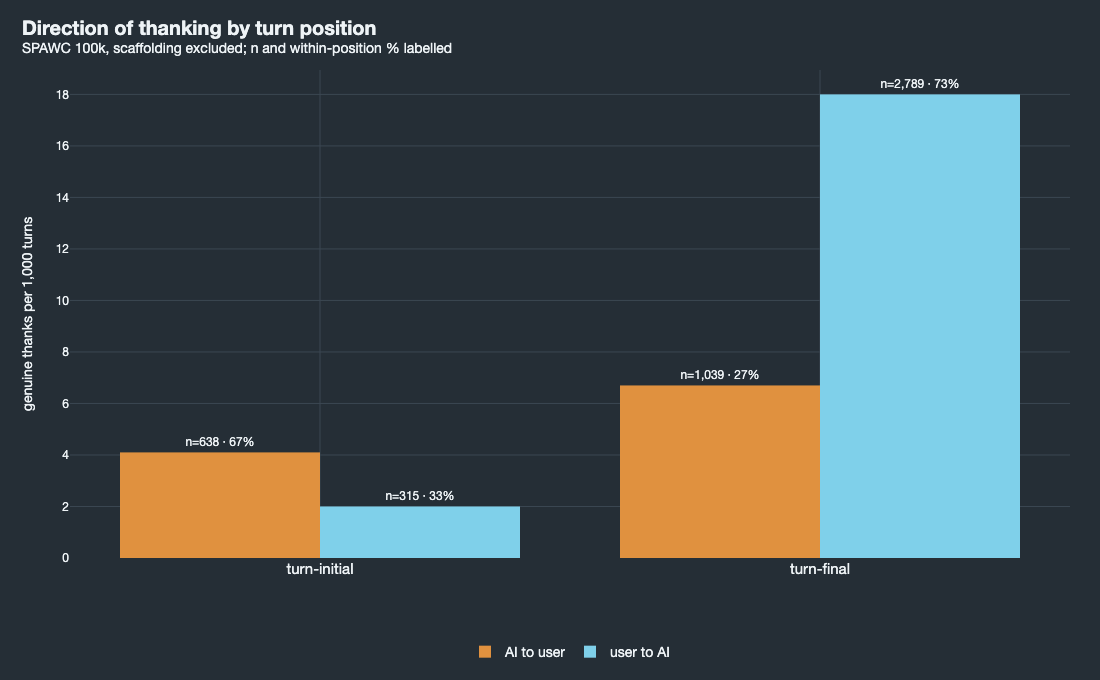
  • The AI thanks to OPEN a turn; users thank to CLOSE.
  • AI gratitude is substantive (it gives a reason); ours is ritual (a bare ‘thanks’).
  • Methodological difficulty: many ‘thanks’ are embedded in genres like thank-you letters.
  • Thanking behaviour shifts by model generation.

Speech Acts and AI: Initial take-aways

  • What humans and AI do in interaction can be described using existing linguistic theory
  • Speech Acts such as thanking do occur on both sides of the conversation, but typically in different places and with different functions

We need to look more closely, some open questions:

  • What are the intentions, goals etc. that inform specific Human-AI interactions?
  • How do our understanding of AI identity and our and the AI’s pragmatic behaviour influence each other?

Outlook: Next lecture

  • Next session: from single speech acts to whole interactions with AI: openings, repair and closings.
  • Bring your laptops! We will replicate part of House and Kadar’s (2024) cross-cultural study about extractors and extracting (i.e. leaving a conversation)
  • Looking further: how talking to AI may reshape how we talk to each other.

Thank you for your attention.

Contact me at:

House, J., & Kádár, D. Z. (2024). An interactional approach to speech acts for applied linguistics. Applied Linguistics Review, 15(4), 1695–1715.

Huang, Y. (2014). Pragmatics (Second edition). Oxford University Press.

Messerli, T. C. & Locher, M. A. (2021). Humour support and emotive stance in comments on Korean TV drama. Journal of Pragmatics, 178, 408–425.

Beisswenger, M. & Pappert, S. (2019). How to be polite with emojis. Linguistik Online, 97(4), 231–253.

Searle, J. R. (1975). A taxonomy of speech acts. In Gunderson, K. (ed.) Minnesota studies in the philosophy of science 9: language, mind and knowledge, 344–69.

Research programme

The pragmatics of digital and AI-mediated communication

Language as social action in mediated settings, studied with corpus, discourse and qualitative methods.

Click an area to zoom in.

Key areas of expertise

  • Pragmatics (core): Editor of Pragmatics & Society; three Cambridge Elements (Pragmatics in Translation; Corpus Pragmatics; Fiction and Pragmatics)
  • Corpus and digital discourse analysis: building and querying large research corpora
  • Humour, evaluation and pop culture: telecinematic humour, streamed stand-up comedy specials, K-drama audiences
  • Digital-humanities methods and infrastructure: annotation, corpus query, Python and R, server administration

Track record: four monographs and around twenty articles and book chapters.

↩︎ Research map

Current projects: AI-dentities

AI-dentities (flagship)

  • How are relationally loaded speech acts (praise, thanking, apology) realised in human-AI exchange, and how do users position the system?
  • Findings from two 2026 talks: praise behaves like a turn-opener and peaks in GPT-3.5; in thanking, the AI opens and users close, and the AI’s gratitude is substantive while ours is ritual.
  • Data: user-donated chatbot corpora (SPAWC, SPALMSYS). SNSF Starting Grant submitted May 2026, decision pending.

Current projects: debating cultures

Digital Debating Cultures (r/ChangeMyView)

  • The CopRe network, which I co-founded, and a 670-million-word r/ChangeMyView corpus
  • Persuasion, stance and community practice: a digital sociolinguistics of how people argue and change their minds online
  • Recent output: Messerli, Dayter, Leuckert et al. (2025), Digital Scholarship in the Humanities

Current projects: K-drama comments and subtitles

K-drama comments and subtitles (with Miriam Locher)

  • Audience communities around subtitled Korean TV drama: humour support, emotive stance and evaluation in timed comments
  • Subtitles as textual agents, and the circulation of evaluative stance online
  • Outputs in the Journal of Pragmatics and Discourse, Context & Media

↩︎ Research map

Future research

  • Communicative competence with AI: consolidate AI-dentities into a larger programme; intended vehicle, an ERC Consolidator application
  • GenAI, language and pedagogy: a bridge from my PROF-L language-assessment work to the BA Digital Media and Communication
  • Streamed stand-up comedy reviews: evaluation and humour in online reviews of comedy specials, a line I plan to develop with Camilla Vásquez

↩︎ Research map

Research environment

Enhancing the department’s environment

  • Natural collaborations at Reading: Rodney Jones (mediated discourse, GenAI), Christiana Themistocleous (sociolinguistics of multilingualism), Sylvia Jaworska (corpus and professional discourse), Tony Capstick (language and migration)
  • Ongoing partnerships: Miriam Locher (K-drama), Camilla Vásquez (comedy reviews)
  • What I bring: the international CopRe network, ready corpus infrastructure, and a journal editorship

Contribution to the REF

  • Outputs: a live pipeline at world-leading and internationally excellent quality (DSH 2025; a 2026 Springer book chapter; AI-dentities outputs to come)
  • Impact: a developing case study on critical GenAI literacy in education and assessment
  • Environment: grant capture (SNSF redirected to UK schemes, then ERC), PhD supervision, and network and editorial leadership

↩︎ Research map

Thank you

Happy to discuss any of these in more detail.